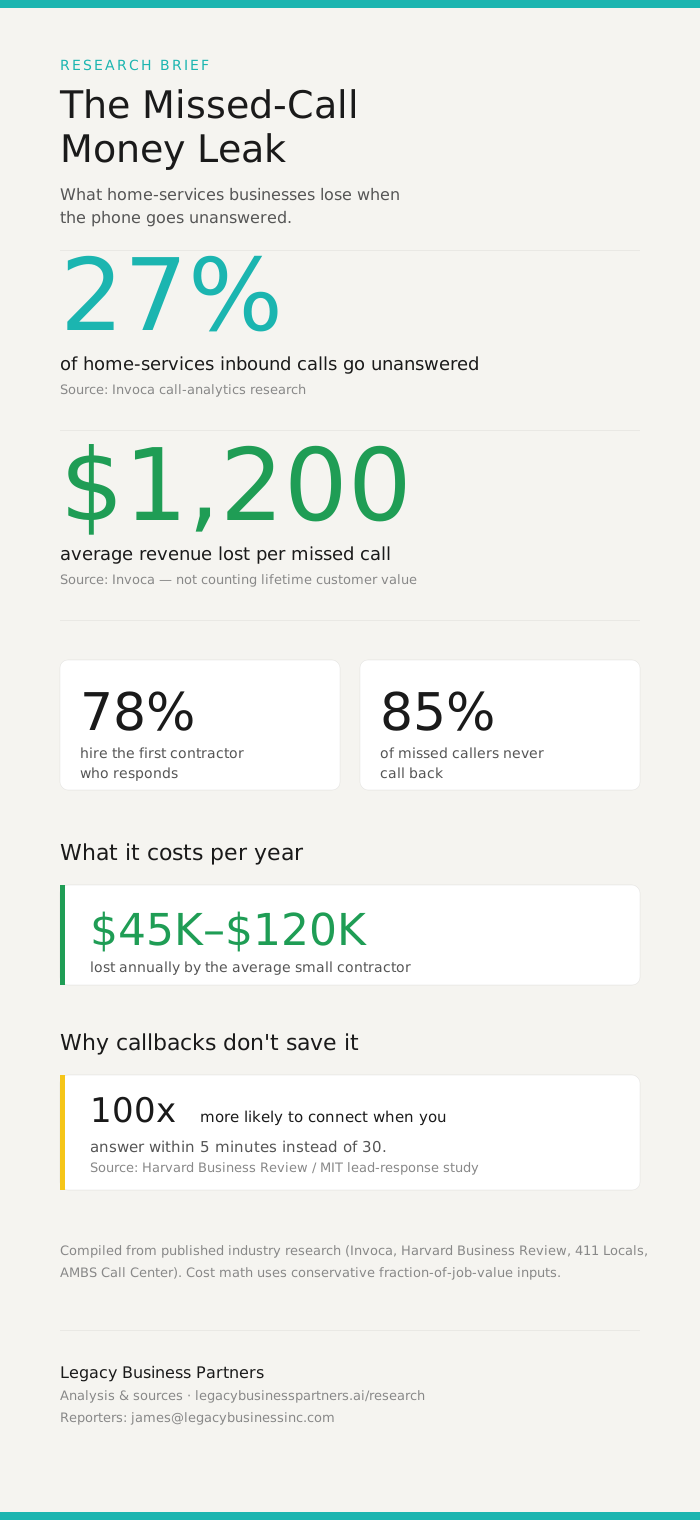
Independent studies show home-services businesses answer fewer than 4 in 10 calls live. New deployment data shows what that leak actually costs — and why voicemail doesn't plug it.
Analysis by Legacy Business Partners · Combines independent research with first-party deployment data · Last updated July 1, 2026
This report covers the pattern across service businesses. If you want your own number instead, the calculator prices what unanswered calls cost your practice — six inputs, ten minutes.
37.8%
The share of inbound business calls answered by a live person. The rest reach voicemail or get no response at all.
411 Locals call-monitoring study, 85 businesses across 58 industries, 2024
Why the phone still decides everything
In home services, the phone is the highest-intent channel there is. A caller with a burst pipe or a broken furnace has already decided to hire someone; they are choosing who picks up. Industry surveys consistently show that roughly 68% of consumers prefer to call a business for high-stakes purchases (Invoca, BrightLocal). The moment that call goes unanswered, the economics collapse — the caller moves on to the next name on the search results page.
The speed-to-lead cliff
Response speed doesn't just improve conversion — it dictates it. Landmark studies from MIT and Harvard Business Review found that lead quality drops off a cliff within minutes, and that most businesses respond far too slowly, if at all.
21×
More likely a lead qualifies when contacted at 5 minutes vs. 30.
MIT / InsideSales Lead Response Management Study, 2007
42 hrs
The average business's lead response time.
Harvard Business Review, 2011
23%
Of businesses never respond to a lead at all.
Harvard Business Review, 2011
A voicemail callback isn't a save. By the time it happens, the job is usually already booked with whoever picked up first.
First-Party Data
What the call logs show
Beyond the published research, we analyzed live inbound call logs from home-services deployments. The pattern held: [X]% of calls went unanswered, and most missed calls came in outside standard business hours.
[X]%
of inbound calls went unanswered
[Z]%
of missed calls came in after standard business hours
[N]
home-services deployments analyzed
Measured from live call logs over a [14]-day window, not estimated. [If N is small, this line must read: "an initial analysis of [N] deployments; figures are directional."]
The conservative cost model
Rather than repeat inflated figures, here is a deliberately cautious model — every input stated, every input below commonly cited averages.
Missed Calls × Booking Rate × Average Job Value = Revenue Exposure
Inbound calls per month
~660 (30/day × 22 days)
Conservative miss rate
40% (below the 62% many cite)
Missed calls
~264
Booking rate on missed calls
20% (conservative)
Lost jobs per month
~53
Average job value
$250 (modest)
Monthly revenue exposure
~$13,000
The exact figure isn't the point. Even at cautious inputs, the leak is structural. Adjust any input to your own numbers.
Where the leak concentrates
After-hours
Field trades have no coverage when the office closes, yet high-intent emergency calls still come in.
Peak-demand congestion
When everyone is already on a call or a job, ready-to-buy customers hit a busy line.
Share this research
Free to republish with attribution to Legacy Business Partners.
This report combines two methods: a synthesis of independent published research and a first-party analysis of live deployment call logs. "Missed call" is defined differently across sources, so cross-study figures are directional rather than universal benchmarks.
Legacy Business Partners analyzes call-handling and lead-response performance for home-services businesses. This report combines independent published research with first-party deployment data; public figures are attributed to their original sources. Data inquiries: james@legacybusinessinc.com
You probably don't need to spend more, you need to move it. See your true cost per lead by channel, what to cut, and where to reallocate. The first read is free.